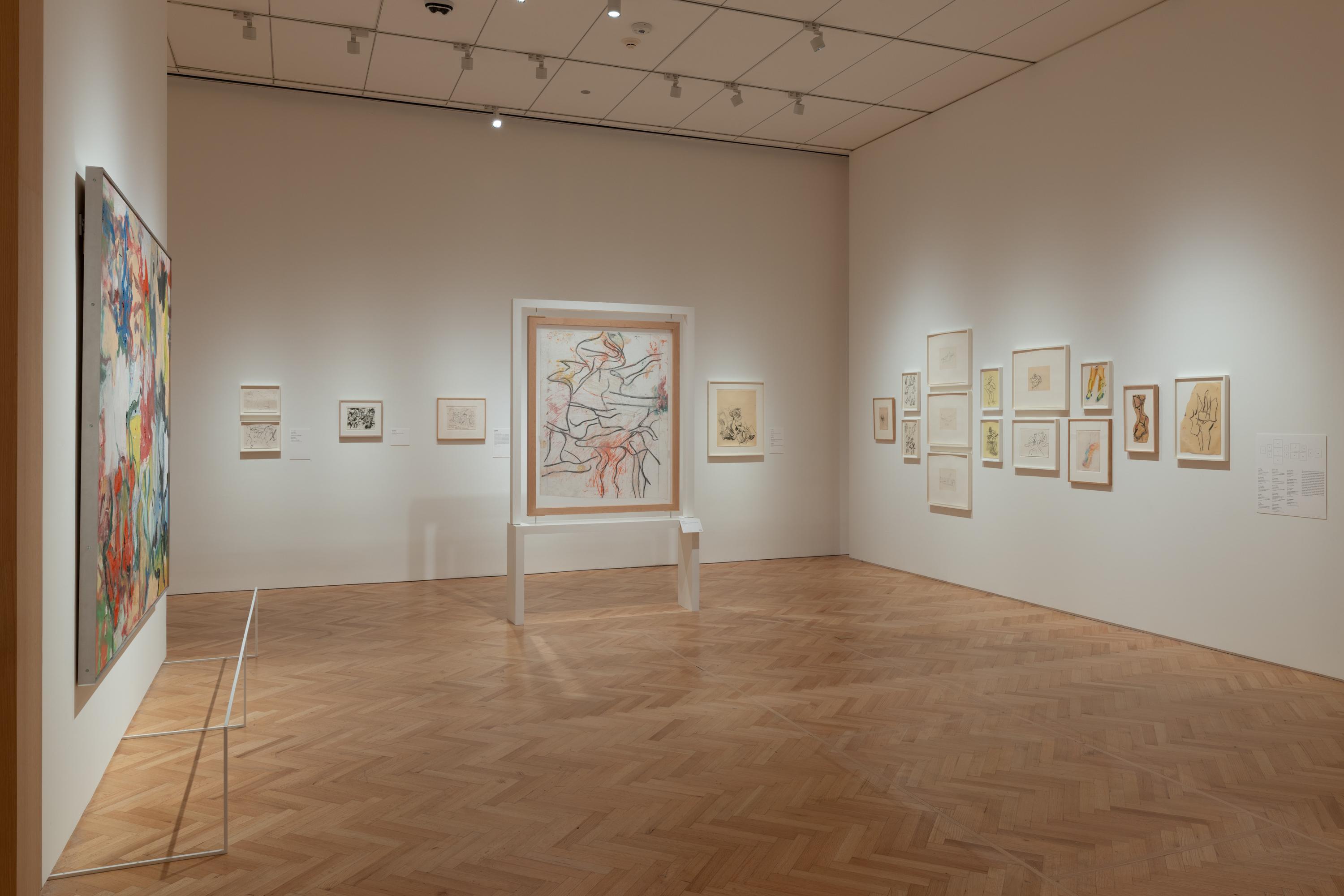
A seminal exhibition, Willem de Kooning: Drawing, is now on view at the Art Institute of Chicago.
Willem de Kooning (1904–1997) was one of the most celebrated and prolific artists of the twentieth century, whose practice consistently challenged the boundary between figuration and abstraction. This major gathering of works from esteemed collections across the globe reveals how the act of drawing was foundational to de Kooning's entire artistic process and production – his paintings, sculptures, and printmaking, as well as his drawings – and showcases the totality of his graphic production, from his earliest existing works to his late calligraphic paintings.
Rather than following the pure abstraction favored by many of his contemporaries, de Kooning kept returning to the human figure, famously insisting that "flesh was the reason why oil painting was invented." The body remained a constant source of experimentation throughout his career. Forms melt, fracture, and reassemble across his surfaces, and in his well-known Woman series, the figure shifts between something powerful and confrontational and something more fragile and dissolved. This tension between figuration and abstraction placed him at the center of the postwar New York scene, alongside artists like Jackson Pollock, Franz Kline, and Joan Mitchell.
Rigorously trained in academic draftsmanship at the Rotterdam Academy of Fine Arts prior to his emigration to the United States in 1926, de Kooning articulated a conviction central to his practice: "I draw in paint, and usually I don't feel so much difference between drawing and painting." Compelled to continually innovate and surprise even himself, de Kooning began experimenting with unconventional drawing methods, such as working with his eyes closed, which opened up new directions for his art. He also often reused forms from his earlier artworks and adapted tools and techniques from his career as a commercial artist, resulting in a body of work that is both self-referential and inventive.
The exhibition also shows how de Kooning worked with unconventional materials to achieve his fast, fluid lines. He used cheap enamel house paint, house painters' brushes, and carbon paper transfers to cut, layer, and collage fragments of drawings directly onto his canvases. Through constant erasure, scraping, and rebuilding, his works rarely settle into a single, final image – they feel instead like they're still in motion. Taken together, the exhibition offers a rare look at a drawing practice that changed what modern art could look and feel like.
Peder Lund Art Advisory Associates has engaged with de Kooning's body of work over many years, and has placed works by the artist in important museum and private collections. We are pleased to highlight this significant institutional presentation, in keeping with our sustained engagement with the discourse surrounding the defining figures of modern and contemporary art.
Installation view, Willem de Kooning Drawing, Art Institute of Chicago, June 14–September 20, 2026. © 2026 The Willem de Kooning Foundation / Artists Rights Society (ARS), New York.