"Beauty is the mystery of life. It is not just in the eye. It is in the mind."
— Agnes Martin
Peder Lund Art Advisory Associates is thrilled to have facilitated the acquisition of Agnes Martin's Untitled #8 (1999) by an esteemed private collection.
Agnes Martin (1912–2004) is one of the defining figures of postwar American art, and her place in the canon has only grown with time. Her honors include the Golden Lion for lifetime achievement at the 1997 Venice Biennale and the National Medal of Arts in 1998. In 2015–16, a major retrospective at Tate Modern, the Kunstsammlung Nordrhein-Westfalen in Düsseldorf, the Los Angeles County Museum of Art and the Solomon R. Guggenheim Museum introduced her to a new generation.
Martin was born on a farm in Macklin, Saskatchewan, and studied at Columbia University and the University of New Mexico. In 1957, she moved to New York and took a studio at Coenties Slip in lower Manhattan. There she worked alongside the Abstract Expressionists as well as the younger artists who would go on to shape Minimalism. Her friendships with Ad Reinhardt, Barnett Newman and Ellsworth Kelly influenced her deeply. By around 1960 she had arrived at the grid, and with it the strict focus on line and plane that defines her mature work. Although she is often grouped with the Minimalists, Martin saw her paintings as expressions of positive human emotion: innocence, happiness, joy, and love.
In 1967, at the height of her New York reputation, Martin left the art world. She drove west in a pickup truck and eventually settled on a remote mesa in New Mexico, and she did not paint again for nearly seven years. When she returned to painting, the grid gave way to horizontal bands of pale, luminous color, the format that would carry her through the rest of her career. She spent her final years in Taos, where she kept working daily in her studio and painted Untitled #8.
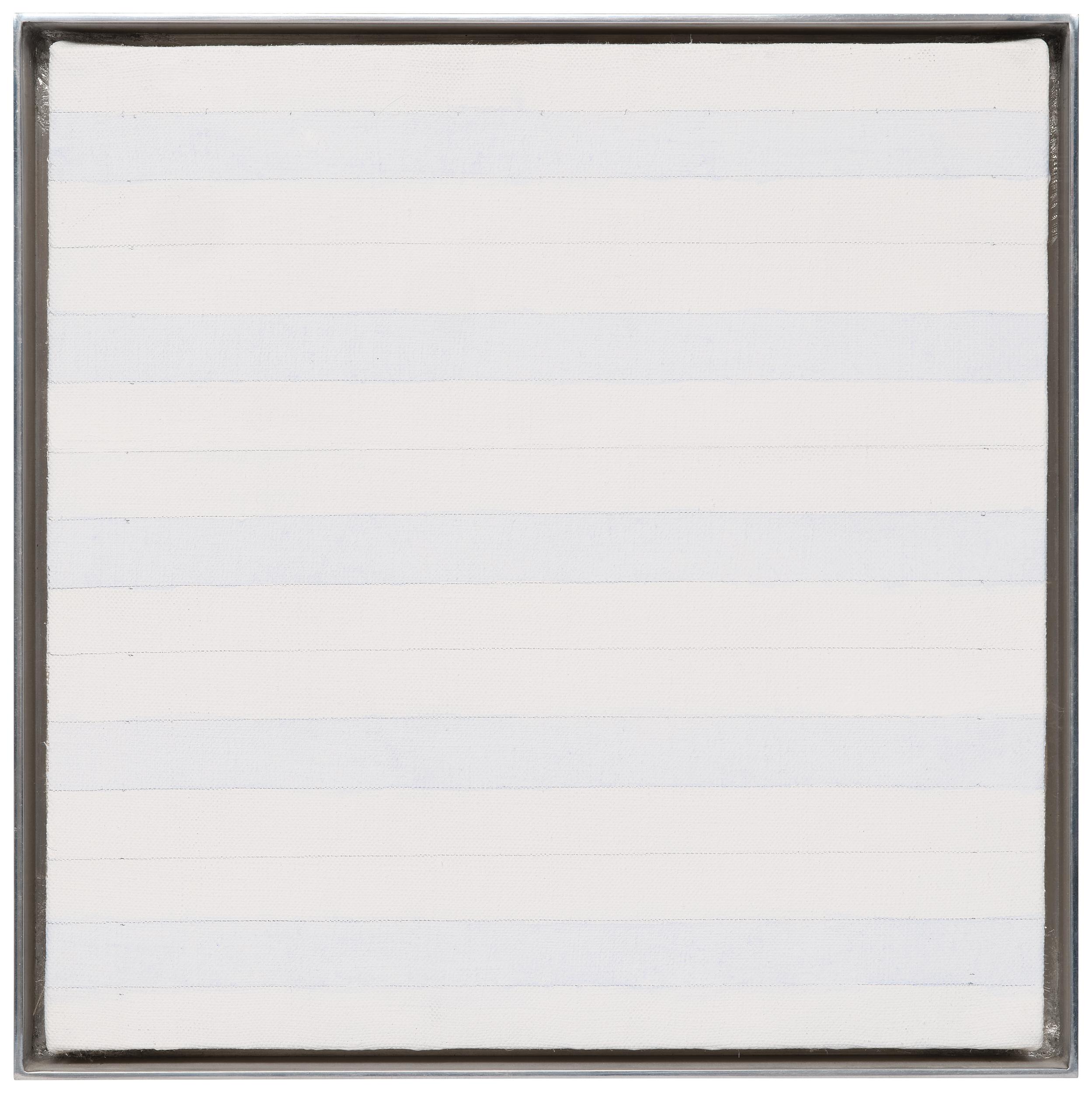
Untitled #8 is a small, concentrated statement of Martin's late style. On a 12 × 12 inch canvas, bands of pale blue alternate with bands of warm, unpainted cream. Fine graphite lines, drawn freehand across the surface, divide the canvas into even intervals. Small pencil marks along the edges record how she measured those intervals by hand. The acrylic is laid on in thin, even washes, so the weave of the canvas shows through, and the blue seems to glow rather than sit on the surface. Up close, you can see how carefully it was made. From a distance, it reads as a single field of soft light.
Martin's late paintings were usually 60 inches square, so a canvas this small is extremely special. At just 12 × 12 inches, it shows her working at an intimate scale: quiet, exact, and full of light. The small size draws the viewer close, making the experience of looking private and absorbing.
In 2000, the Whitney Museum of American Art included Untitled #8 in Lovely Life: The Recent Work of Agnes Martin, an important museum exhibition of her late work. The painting is recorded in the artist's catalogue raisonné as no. 1999.008.
Late works by Martin with this combination of quality, size, and museum exhibition history rarely come to market.
We are delighted that the painting has found a permanent place in a respected private collection.
Image: Agnes Martin, Untitled #8, 1999. Acrylic and graphite on canvas, 12 × 12 in. (30.5 × 30.5 cm). Private collection, courtesy Peder Lund Art Advisory Associates. © Agnes Martin Foundation, New York / BONO, 2026