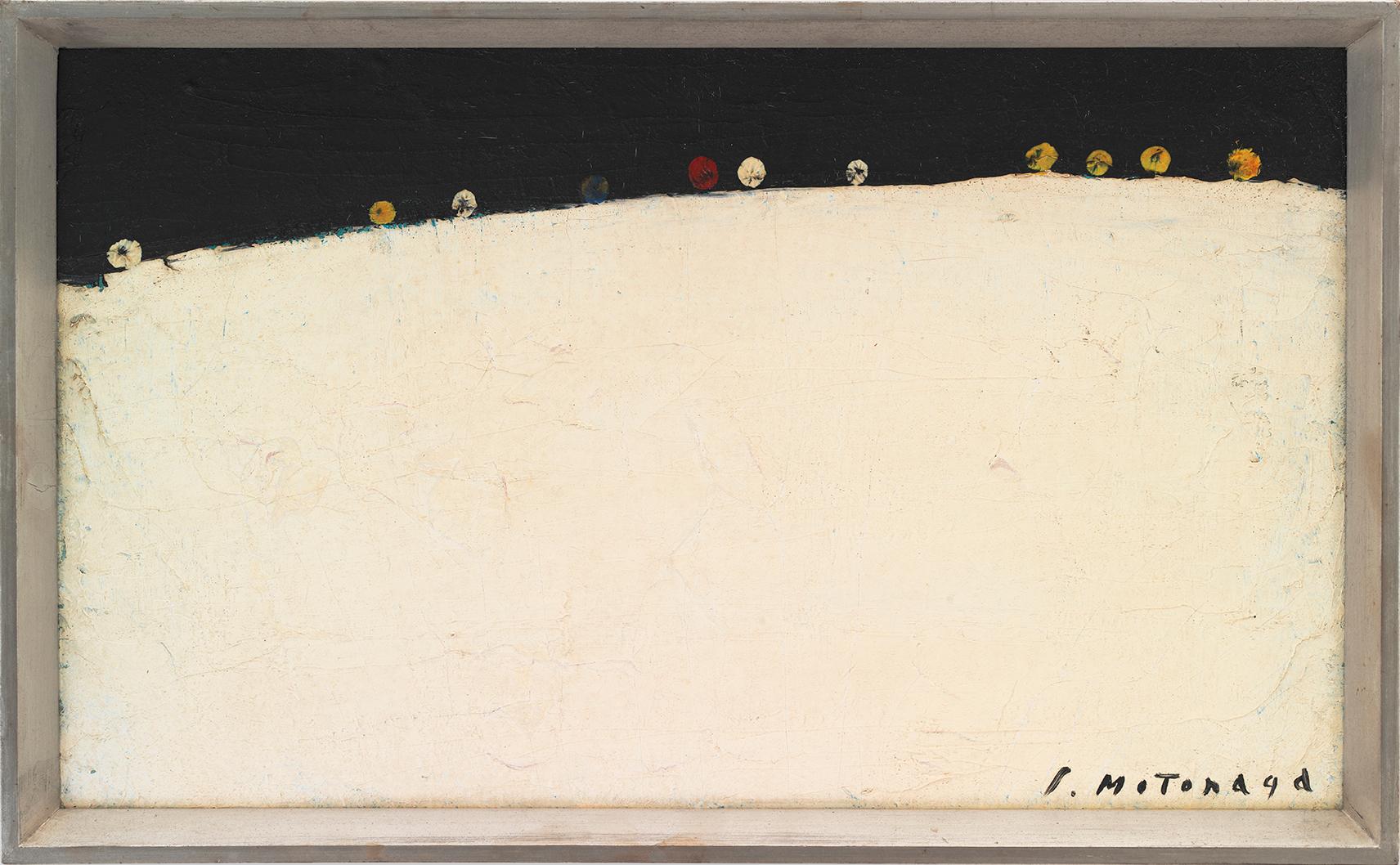
We are pleased to announce the placement of "Sakuhin" (1954–55) by Sadamasa Motonaga into a distinguished private collection.
"Sakuhin" (1954–55) is among the earliest and most historically significant works by Sadamasa Motonaga (1922–2011): an oil on canvas of quiet formal authority that was included in The 1st Gutai Exhibition at Ohara Hall, Tokyo, in October 1955, the founding public statement of one of the most important avant-garde movements in postwar Japanese art. Motonaga joined the Gutai Art Association in 1955, the year of the group's first exhibition, and this painting stands as one of the defining early statements of both his individual practice and the Gutai movement's founding philosophy. At first glance, "Sakuhin" appears deceptively restrained: a gently sloping expanse of white rises into a band of deep black, punctuated along the horizon by a procession of small, hand-applied colored dots. Yet its simplicity is precisely what makes it so significant — Motonaga distilled form into an elemental language of line, field, and mark while maintaining an unmistakable sense of wit and levity.
In the context of the 1955 Ohara Hall exhibition, "Sakuhin" served as a crucial counterpoint to the explosive gestures of Motonaga's peers. Where artists such as Kazuo Shiraga or Saburō Murakami foregrounded the body's violence and the drama of material encounter, Motonaga proposed a different kind of rupture: one rooted in subtlety, rhythm, and the poetic transformation of minimal means. His use of the dot, a motif that would become central to his oeuvre, signaled a shift in Japanese postwar painting toward forms that resisted both Western abstraction's heroic machismo and the strictures of Japanese academic tradition. The dots in "Sakuhin" march across the upper register like comic characters or celestial bodies, establishing a playful tension between the cosmic and the childlike that would prove remarkably prescient: the painting anticipates themes later central to the Superflat generation, including Takashi Murakami and Yoshitomo Nara, who drew directly from Motonaga's pioneering integration of pictorial flatness, pop color, and non-hierarchical visual culture.
By 1957, Motonaga's painting had become increasingly abstract, characterized by bold pigments poured or pooled into flowing organic shapes, a "High Gutai" approach that culminated in his 1960 solo exhibition at Martha Jackson Gallery in New York, one of the earliest major presentations of Gutai art outside Japan. A work of this historical moment, with a documented exhibition history traceable to the movement's very first public appearance, represents an exceptional and irreplaceable object in the history of postwar global art.
Peder Lund Art Advisory Associates negotiated and finalized this acquisition on behalf of a distinguished private collection.