Peder Lund Art Advisory Associates is proud to have been among the supporters of "Ellsworth Kelly: At the Edge of Water" at the Fondation Maeght in Saint-Paul-de-Vence, through a significant loan and financial support of the exhibition. The relationship between Kelly and the Maeght family is one of the formative partnerships in postwar art history; that it should be honored with this exhibition, the first ever to trace the theme of water across the full breadth of his practice, is both fitting and long overdue. Peder Lund's connection with Ellsworth Kelly and his studio spans the final decade of the artist's life, and our relationship with Jack Shear — Kelly's partner and the director of the Ellsworth Kelly Foundation, who remains among Kelly's closest advocates — continues with great warmth and mutual respect. It is a particular honor to have played a role in bringing this exhibition to fruition.
Ellsworth Kelly (1923–2015) occupies a position in twentieth-century art that resists easy summary, though the outlines of his achievement are by now firmly established. Born in Newburgh, New York, he served in the U.S. Army during the Second World War and afterward, in 1948, returned to France to study at the École des Beaux-Arts in Paris. He remained in France until 1954, and those six years were decisive. In Paris he encountered Surrealism, concrete abstraction, and the tradition of close observational drawing that ran from Cézanne through Matisse; he befriended Sophie Taeuber-Arp and Jean Arp; he walked constantly through the city, looking at windows, shadows, archways, and the surfaces of water with an intensity that never left him. His early relief panels, his first shaped canvases, his extraordinary plant drawings — all were begun in France, and all carry the mark of that sustained attentiveness to the visual world that characterizes French modernism at its most rigorous.
Among the most consequential connections he made in these years was with the Maeght family. He exhibited at Galerie Maeght in Paris and stayed regularly with the family at Saint-Paul-de-Vence, developing a friendship with Adrien Maeght that would last throughout his life. The Fondation Maeght, when it opened in 1964 — designed by Josep Lluís Sert, with works by Calder, Miró, Giacometti, and Braque integrated into its architecture — was immediately recognized as one of the great institutions of European modernism, and Kelly's connection to it placed him, from the outset, within that tradition.
Kelly's mature practice was built on a proposition that was both extremely simple and extremely difficult to execute: that form, color, and shape, apprehended with sufficient precision and commitment, could be translated directly from the world into painting without the intervention of conventional representation. "In my paintings," he said, "I do not invent; my ideas come from a constant investigation of the appearance of things." The shaped canvas, the monochrome panel, the spectrum piece — works in which color appears not as pigment applied to a ground but as an autonomous physical presence, a thing occupying space — are the formal consequences of that proposition taken to its logical end.
His color panels are perhaps the works for which he is most immediately recognized: large, often room-scale canvases of a single color, or sequences of abutted colors, that function less like paintings in the traditional sense than like presences — objects that impose on the space around them, altering its light, its temperature, its spatial character. The shaped canvases extend this further, bending the boundary between painting and sculpture: forms cut from the canvas support itself, so that the thing that contains the color and the form that the color takes are one and the same object. The distinction between figure and ground, fundamental to Western painting from the Renaissance to abstract expressionism, is simply set aside.
Alongside this body of work in painting and sculpture, Kelly maintained throughout his life a practice of drawing from nature — from plants, from water, from the structural arrangements of the visible world — that has only recently received the sustained critical attention it deserves. His plant drawings, precise and warm, are among the most technically accomplished drawings in the American tradition. His collages, which take the found postcard as their material — images clipped, arranged, and pasted to reveal the underlying geometry of landscape, coastline, and light — represent yet another dimension of a practice of remarkable breadth.
"Ellsworth Kelly: At the Edge of Water," curated by Éric de Chassey, is the first exhibition to examine the role of water specifically within this practice. It is a theme that ran through Kelly's entire working life. He was drawn repeatedly to aquatic environments — to Belle-Île and the Côte d'Azur during his Paris years; to the Caribbean and the coasts of New York in the decades that followed — and from these experiences of looking at water he generated, over more than half a century, a body of drawings, collages, paintings, and sculptures that has never before been gathered and examined as a distinct thread.
The reason this theme is significant is not merely biographical. Water, as a subject, posed for Kelly exactly the formal problems that interested him most. Water has no fixed color: it takes the color of the light falling on it, of the sky above it, of the depth below. It has no fixed form: it moves, it divides, it reflects, it distorts. Yet it has a surface, a weight, a physical presence. Looking at water was, for Kelly, a way of looking at perception itself — at the conditions under which color and form become visible, and at the gap between the thing seen and the thing known. The works in this exhibition, which span from the early 1950s to the final years of his practice, show how that sustained engagement with water shaped his understanding of what painting could do.
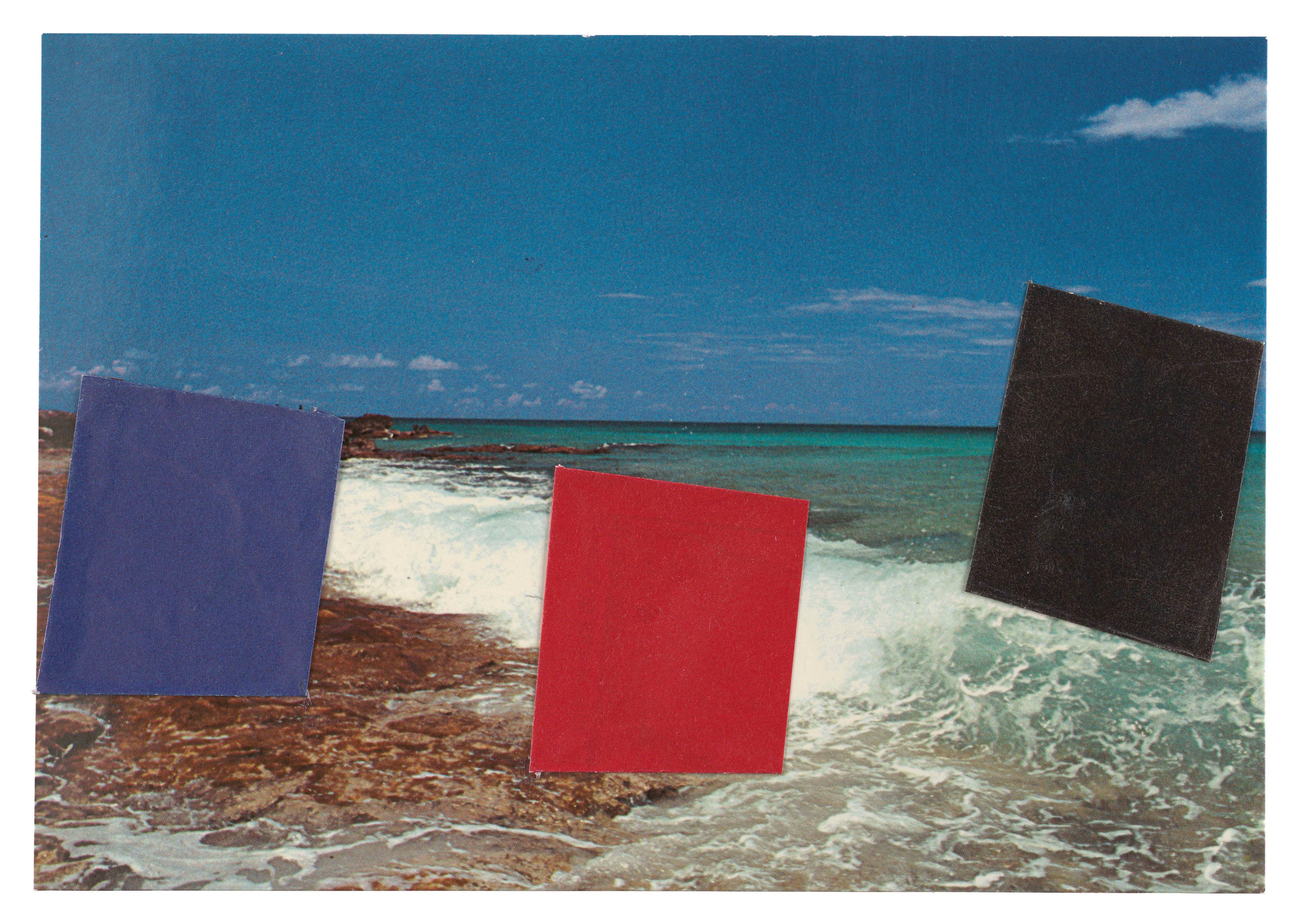
Among the works in the exhibition is "Blue Red Black" (1994), a postcard collage from a distinguished private collection advised and guided by Peder Lund Art Advisory Associates. The loan of this work to the Fondation Maeght is one we were pleased to facilitate on behalf of its owner, whose long relationship with our advisory practice has enabled the placing of exceptional works in exactly the institutional contexts they deserve.
The postcard collages hold a particular place within Kelly's practice. Beginning in the 1960s and continuing through the final decades of his career, he worked with the postcard as a found object and a pictorial field — a small, saturated image of a landscape or coastline that could be cut, cropped, and rearranged to reveal the abstract geometry concealed within its photographic surface. The process was not illustrative but analytical: Kelly was not making landscapes from photographs, but using the found image to isolate and extract the formal conditions — the horizon, the plane, the edge — that interested him in the visible world itself. The collages are working documents and finished works simultaneously; they are the place where perception and abstraction meet most directly.
"Blue Red Black" (1994), with its characteristically Kelly-esque structure — the interplay of saturated primary color against a found photographic ground — embodies this dual character with particular clarity. That a work of this refinement and importance should appear in the context of this exhibition, in the institution where Kelly's deepest French affiliations were formed, makes its inclusion entirely right.
Peder Lund's engagement with Ellsworth Kelly and his practice deepened considerably during the last decade of the artist's life. In those years, Peder developed a working relationship with the studio that gave him direct insight into Kelly's practice, his intentions, and the vast holdings of the estate — a relationship that has continued, with undiminished warmth, into the years since Kelly's death in 2015, through an ongoing friendship and professional collaboration with Jack Shear, Kelly's partner, the director of the Ellsworth Kelly Foundation, and the principal steward of the artist's legacy.
That relationship has informed our work with Kelly's works across the full range of our advisory activities — placing works in private collections that we believe will care for them with the seriousness they require, facilitating loans to institutions that can bring them before the audiences they deserve, and providing our clients with the kind of authoritative guidance that comes from direct, sustained engagement with the studio and estate. The Fondation Maeght exhibition is a natural expression of those commitments, and our financial support for the exhibition reflects our belief in the importance of this particular institutional relationship between Kelly and the Maeght legacy being honored at the highest level.
"Ellsworth Kelly: At the Edge of Water" is on view at the Fondation Maeght, Saint-Paul-de-Vence, through November 15, 2026.