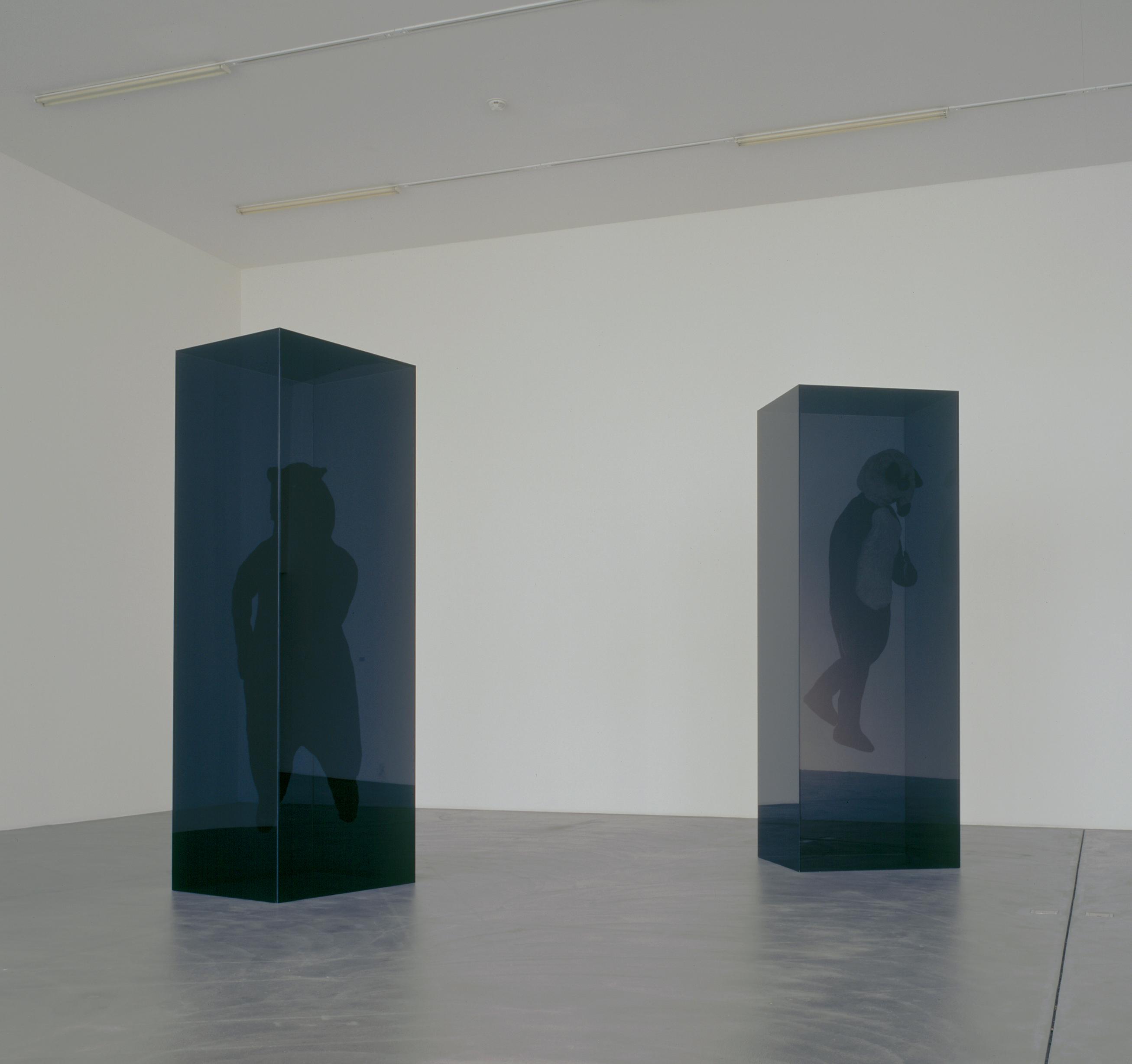
Peder Lund Art Advisory Associates is pleased to announce the placement of "Rat and Bear (Vitrines)" (1983/2004) by Peter Fischli and David Weiss into the permanent collection of an esteemed institution.
Since the late 1970s, Peter Fischli (born 1952) and David Weiss (1946–2012) developed one of the most consistently surprising and philosophically searching practices in postwar art. Working across sculpture, photography, video, film, and artist's books from their base in Switzerland, the duo brought to contemporary art an attitude at once deeply serious and productively absurd — indebted to Dada, Surrealism, Pop, and Conceptual art, yet firmly their own. Their best-known work, the film "The Way Things Go" (1987), in which a Rube Goldberg chain of events transforms studio detritus into something vertiginous and beautiful, established the terms of their practice: humble materials, keen observation, and an uncanny wit that refuses to separate the comic from the profound.
The rat and the panda bear at the center of "Rat and Bear (Vitrines)" have their origin in a bluff. Around 1980, Fischli and Weiss were living in Los Angeles — Weiss had relocated from 1979 to 1981, and Fischli was on an extended visit. During his first weeks in the city, Fischli encountered a Hollywood costume supply store he could not enter without professional credentials. He returned the following day with Weiss, the two posing as film directors. Asked what they were looking for, they answered "animal costumes" on the spot — and were immediately drawn to the shabby, unglamorous figures of a brown rat and a panda bear. Where the other costumes struck them as too Disney-like, these two had a worn, unpretentious quality that resonated. As Fischli later explained: "The panda is one of the rarest animals in the world, while the rat overruns the planet. The panda is threatened with extinction because it cannot adapt to new conditions. The rat is shrewd and intelligent and can adapt to any living conditions. The panda never evolved and feeds on bamboo, while the rat eats rubbish." The contrast was irresistible. They rented the costumes for $100 a month — money they barely had — and turned the lie that got them into the store into the truth that would anchor their practice for decades.
The costumes first appeared in "The Least Resistance" (1980–81), a deadpan film in which Rat and Bear drift through the art world and the underworld alike, seeking status, meaning, and the path of least effort. Their dynamic drew consciously on the archetype of the literary and cinematic comic duo — Pat and Patachon, Laurel and Hardy — while redirecting that tradition toward something more oblique and more unsettling. Because the animal masks had no perceivable mouth movements, the film was shot silent on Super 8 and dialogue was written only afterward, lending the whole enterprise an eerie, dubbed quality that amplified its comedy. A second film, "The Right Way" (1983), followed. After its completion, the artists packed the costumes away with no firm intention to return to them.
They remained in storage for over twenty years. In 2004, the French artist Dominique Gonzalez-Foerster was planning "Multiverse," a solo exhibition at Kunsthalle Zürich, and asked Fischli and Weiss whether they would consider resurrecting Rat and Bear — her proposal was for an ongoing live performance, the characters roaming the galleries and engaging in philosophical conversation. The artists declined. Instead, they proposed a counter-solution: placing the original costumes inside two monumental black Plexiglas vitrines, each nearly three meters in height, so that the stuffed figures appear to float in suspension. Rather than perform, they "celebrated the objects as fetishes." The effect is unlike anything else in their practice — or in contemporary sculpture more broadly. Critics noted that the vitrines recalled the mysterious black monolith in Stanley Kubrick's "2001: A Space Odyssey" (1968); they also look like specimens in a natural history museum that have somehow outgrown their category, or like astronauts drifting in antigravitational tanks. The transformation of costume into reliquary turned a refusal into a monument.
"Rat and Bear (Vitrines)" was included in the artists' major retrospective "Flowers and Questions" at Tate Modern, London (2006–07), and subsequently presented by Fondazione Nicola Trussardi in the opulently decorated Palazzo Litta, Milan (2008). The Baroque architecture of the sixteenth-century villa offered an unexpectedly apt setting: it was here, seeing the vitrines in that context, that Fischli and Weiss began to imagine reinhabiting the characters. Rather than simply returning to the costumes — conscious that after twenty years many artists would simply make their work bigger or grander — they cast two small boys to play the roles, producing "Parts of a Film with Rat and Bear" (2009), a three-channel installation presented at the Teatro Arsenale, Milan. In one screen, the original Rat and Bear leave their vitrines to lecture their smaller selves; in another, the miniature pair wander the exhibition; in the third, the large figures float suspended in the air above. The work refuses to say whether the smaller figures are older or younger: "They are possibilities of how you could interpret it," Weiss said. Further iterations followed: "Rat and Bear (Mobile)" (2008–09), in which life-size puppets were suspended from the atrium of the Palacio de Cristal, Madrid, for a dedicated exhibition at the Museo Reina Sofía; and "Rat and Bear (Sleeping)" (2008), shown at the Yokohama International Triennale and later at the Guggenheim Museum, New York, as part of the definitive retrospective "Peter Fischli David Weiss: How to Work Better" (2016), in which the vitrines are illustrated and documented on page 275 of the accompanying catalogue.
"Rat and Bear (Vitrines)" is among the defining works of Fischli and Weiss's four-decade collaboration — an object that is at once art-historical and inexhaustibly strange, funny and elegiac, and entirely resistant to resolution. Peder Lund Art Advisory Associates is honored to have facilitated its placement into an institutional collection of the highest distinction.