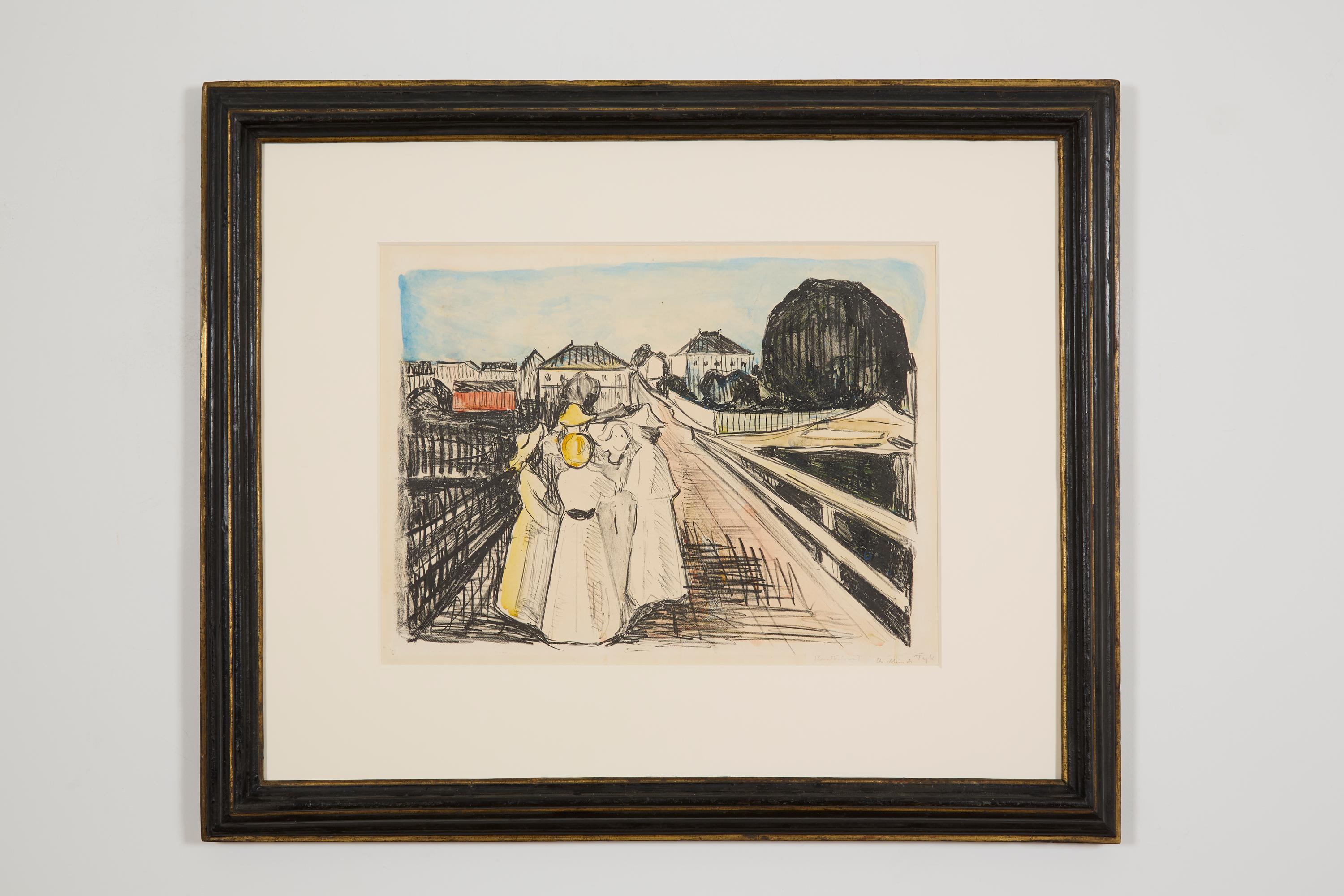
Peder Lund Art Advisory Associates is pleased to announce the acquisition of Edvard Munch's "På broen" [On the Bridge] (1912–13) by an esteemed private collection, with the subsequent reframing of the work to institutional standards under the guidance and recommendation of Peder Lund Art Advisory Associates.
The "Girls on the Bridge" motif is among the most sustained and psychologically charged of Munch's visual preoccupations — a subject he returned to across paintings, drawings, and prints from the late 1890s through the 1930s, and one that is inseparable from his deepening engagement with the small coastal town of Åsgårdstrand, which served as a recurring psychological landscape throughout his career. The painted version of 1901, now in the National Museum of Art, Architecture, and Design, Oslo, is one of the most recognized works in the Norwegian national collection. But it is in the graphic treatments of the motif that Munch's formal intelligence is most nakedly visible, stripped of the atmospheric richness of oil on canvas and reduced to the essential elements of line, void, and mark.
The 1912–13 lithograph is among the most formally concentrated of Munch's graphic treatments of this subject. The composition is rooted in the familiar topography of Åsgårdstrand, viewed from the jetty and directed inland toward the road, the houses, and the large tree mass at right. Yet the image is not documentary. The bridge, rendered through an insistent network of black lines, dominates the sheet and drives the pictorial space inward through a steep perspective, its flanking railings and fences creating a strong visual corridor that generates an almost vertiginous spatial pull. The houses beyond are rendered economically, almost schematically, and the large dark tree at right serves as a weighty counterform to the openness of the pale sky and roadway. This balance between structural severity and atmospheric lightness is central to the print's effect — and to the particular kind of psychological intensity Munch consistently drew from this location.
At the left side of the bridge, three female figures in long white dresses stand clustered closely together. Unlike certain painted variants of the theme in which the women are more individualized or incorporated into a broader social configuration, here they function less as portraits than as a condensed formal and psychological unit. Their faces are only summarily indicated; their long white dresses fuse into a single pale mass. Munch suppresses anecdotal specificity in favor of a more symbolic figural presence. The inwardness of the group — their close physical proximity, their relative detachment from the surrounding space — produces a sense of emotional enclosure within the exposed public setting of the bridge. The bridge becomes more than a topographical element: it is a psychological threshold, a place of passage, suspension, and charged encounter. These tensions between exposure and withdrawal, movement and stillness, structure and atmosphere are central to Munch's mature treatment of this motif across all its iterations.
The hand-coloring of the present impression is of the highest order. Applied with remarkable freshness and restraint, it heightens rather than obscures the lithographic structure. Transparent washes of pale blue unify the sky; warm pinks and ochres animate the bridge and roadway; selected accents of yellow and orange distinguish the foreground figures, one of whom carries a striking circular orange accent — likely hat or hair adornment — that becomes a chromatic focal point of the composition. A red building at the left edge introduces an additional counterpoint. These carefully placed passages of color do not naturalize the scene so much as intensify its emotional register, transforming what might otherwise read as a summer evening into something brighter, sharper, and more psychologically exposed. The impression is an extremely fine one, with the hand-coloring bright and fresh across the entire sheet.
The scholarly significance of this impression within the known corpus of the work is exceptional. Gerd Woll's authoritative catalogue raisonné of Munch's graphic oeuvre — the definitive scholarly reference, published in its first edition in 2001 and its second in 2012, with the present impression cited in both — records only four hand-colored impressions of this composition. Of these four, only two were colored in 1913, at the time of printing: the present impression and one other, formerly in the Epstein Collection and now in the Reitan Family Collection, Norway. The remaining two known hand-colored impressions were not colored until 1934 and 1941, respectively — a gap of two to three decades that places them in a categorically different relationship to Munch's own hand and to the immediacy of the original printing campaign. The 1913 date of the present impression indicates that it was colored by Munch at the moment of the print's making, as an act of direct and concentrated engagement with the sheet, and it is precisely this proximity to the artist's original intention that elevates it above the later impressions in both scholarly and connoisseurial terms.
The impression is signed in pencil by the artist at the lower right: "Handkolorert / Edv Munch / Tryk 1913" — a direct inscription in Munch's own hand certifying both the nature of the coloring and the date of its execution. The sheet bears the watermark of ANDVORD, a prestigious Norwegian stationery and printing company established in 1865 and associated with the finest paper available in Munch's milieu. The work is in an excellent state of preservation.
Following the acquisition, Peder Lund Art Advisory Associates recommended and oversaw the reframing of the work to institutional standards within an original Tuscan Renaissance frame dating to circa 1560 — a frame of exceptional rarity and distinction, selected to complement the chromatic warmth, historical depth, and delicate material presence of the impression. The reframing was executed in close consultation with leading conservators and framers, and represents the kind of ongoing advisory service Peder Lund Art Advisory Associates provides to collectors across the full life of their holdings: from the identification and acquisition of exceptional works to their long-term care, presentation, and contextualization.
This placement reflects the privileged position Peder Lund Art Advisory Associates has established as the foremost private advisor for works by Edvard Munch. Across multiple acquisition cycles, we have identified, evaluated, and placed some of the most significant works in Munch's graphic and painted oeuvre — including rare hand-colored impressions, unique inscribed examples, and major paintings from the Frieze of Life — into distinguished private and institutional collections. Our advisory work in this area is grounded in deep and longstanding scholarly relationships, including with the Munch Museum, Oslo, and in a network of specialist knowledge that enables us to offer collectors access to material of a caliber that is seldom available through conventional market channels. For collectors seeking to build serious and enduring engagement with Munch's work, Peder Lund Art Advisory Associates offers an unmatched combination of scholarly depth, market expertise, and access.
Peder Lund Art Advisory Associates negotiated and finalized this acquisition on behalf of a distinguished private collection.