Peder Lund Art Advisory Associates is pleased to announce the concurrent opening of two major exhibitions at PoMo, Trondheim: Catherine Opie's "Mountains Don't Know Their Names" and Ken Price's "Alien Terrain," both on view from June 25, 2026 through January 3, 2027. Peder Lund is proud to serve on the board of PoMo, working on programming and acquisitions with the board’s chair, art historian Monica Reitan; both exhibitions reflect the museum's sustained commitment to introducing artists of international significance to Central Norway and to the broader Nordic context. Taken together, they constitute one of the most compelling double presentations in PoMo's recent program: two American artists, working in different media and across different generations, brought into an unexpected and illuminating dialogue through their shared engagement with landscape, object, and the material intelligence of the hand.
Catherine Opie: "Mountains Don't Know Their Names"
"Mountains Don't Know Their Names" is the first major solo exhibition of Catherine Opie in Central Norway, and the most ambitious site-specific project she has undertaken in the Nordic region. The exhibition had its origin in a three-week road trip through the Norwegian winter landscape in January 2024. Opie traveled through fjords, mountain passes, and remote coastlines, spending hours and sometimes days with individual mountains in changing weather and shifting light, waiting — in her characteristic manner — for the moment at which a subject reveals its particular energy and presence. What began as a search for the distinctive Norwegian blue light evolved into something more expansive: a sustained meditation on landscape, presence, photography, and the human urge to name and possess the natural world. The exhibition's title distils that reflection. Mountains do not know their names. They exist entirely beyond the stories and meanings we bring to them. Opie's work sits at that threshold.
The exhibition brings together three distinct bodies of work. At its core are 53 large-format photographs from "Norwegian Mountains" — images that function less as conventional landscape documentation than as portraits of nature itself. Opie's formal commitments, to frontality, sustained attention, and the generous scale that demands the viewer's full physical presence, are entirely intact. But here those qualities are directed toward subjects that resist the social and political charge of her earlier portrait work, finding instead a different intensity: the loneliness and grandeur of a mountain face in flat winter light, the trace of a road disappearing into fog, the presence of human infrastructure within a landscape that absorbs and outlasts it. The photographs shift between the documentary and the personal, the monumental and the intimate, without resolving into either.
Alongside the photographs, the exhibition presents 30 ceramic mountain sculptures made both before and after the journey. Part memory, part imagination, the sculptures translate Opie's encounter with the Norwegian landscape into three-dimensional form — objects that hold the experience of the road trip not as record but as residue. Many were developed during her residency at Anderson Ranch Arts Center in Colorado, a place historically connected to Ken Price, who worked there in the 1970s; that coincidence creates a quiet material dialogue between the two concurrent exhibitions, linking two ceramic practices that approach the object from opposite directions. The exhibition is further expanded by two new site-specific video installations by Kate Kunath, an Emmy-winning filmmaker who accompanied Opie throughout the Norwegian journey. Kunath's films offer a poetic, humorous, and intimate account of Opie's working process while reflecting on the broader question of how the act of observation shapes what is perceived.
Catherine Opie (born Sandusky, Ohio, 1961) is widely regarded as one of the most significant photographers of her generation. She studied at the San Francisco Art Institute and completed her MFA at the California Institute of the Arts in 1988. Her practice spans more than three decades and encompasses portraiture, documentary, landscape, and abstract photography, consistently directed toward communities, places, and forms of life that have been overlooked or misrepresented by mainstream American culture. Her early portrait series of LGBTQ+ individuals, produced in the early 1990s, established her as one of the defining documentary voices of that decade; subsequent bodies of work — the "Domestic" series (1995–98), the freeway and civic landscape photographs, the ice fishing houses of the Midwest, the surfer series, the football players — extended that commitment across the full range of American experience. Opie served as Professor of Photography in the Department of Art at the University of California, Los Angeles from 2001 to 2023, and held the department's Lynda and Stewart Resnick Endowed Chair from 2019 to 2024.
Her institutional exhibition record is one of the most distinguished of any photographer working today. In 2026 alone, Opie has presented major solo exhibitions at Fridericianum, Kassel; the National Portrait Gallery, London; and the Royal Scottish Academy, Edinburgh. Previous solo exhibitions include the Museu de Arte de São Paulo (2024), the Henie Onstad Art Centre, Oslo (2017), the Hammer Museum, Los Angeles (2016), the Solomon R. Guggenheim Museum, New York (2008), and the Museum of Contemporary Art, Chicago (2006). Her work is held in the permanent collections of the Guggenheim, the Los Angeles County Museum of Art, the San Francisco Museum of Modern Art, the Museum of Modern Art, New York, the Whitney Museum of American Art, and numerous other major institutions internationally.
Ken Price: "Alien Terrain"
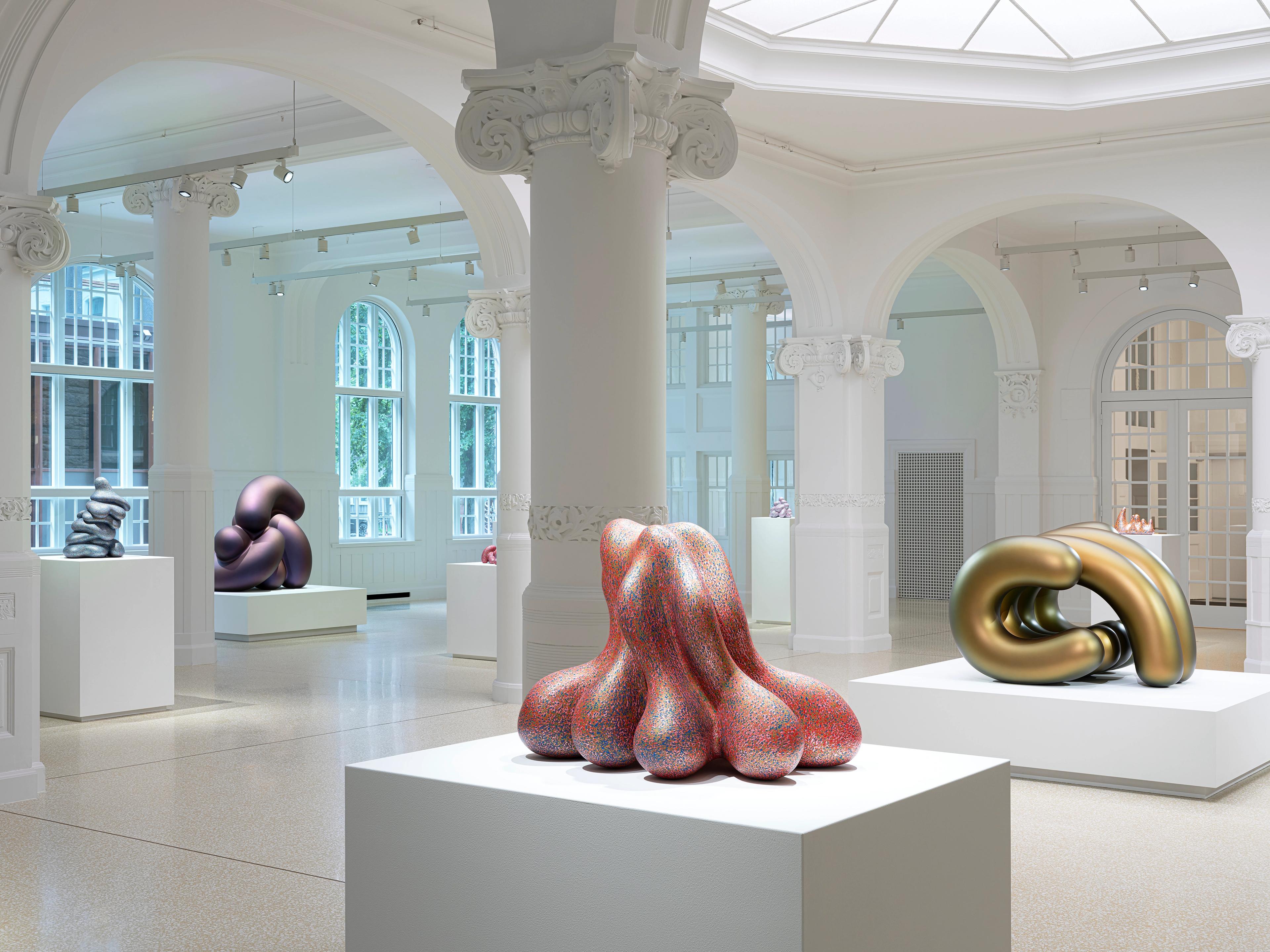
"Alien Terrain" presents 14 sculptures from the late period of Ken Price (1935–2012), spanning 1995 to 2011, in the first solo presentation of his work in Norway. Produced in collaboration with the Ken Price Estate and Matthew Marks Gallery, the exhibition is installed in the Post Hall on PoMo's ground floor and brings into focus the final decades of a practice that redefined the place of ceramics in contemporary art across five decades.
Price committed to clay as a material from the earliest years of his practice — a commitment that, in the context of American art in the 1950s and 1960s, carried a particular significance. Clay was not then a medium associated with serious contemporary art; it carried the weight of craft tradition and decorative function that the dominant movements of the period were determined to leave behind. Price's lifelong project was to demonstrate that this assumption was wrong: that clay could sustain the same level of formal intelligence, conceptual ambition, and visual intensity as any other medium, and that its particular properties — tactility, surface, the trace of the hand in the material, the vulnerability of the object to fire — were conditions to be exploited rather than limitations to be overcome.
His approach drew on a wide range of references: organic and geological form, Mexican folk art, the surf culture of Southern California, the color and improvisation of jazz, the visual vocabulary of science fiction and comic illustration. Price was also a skilled illustrator, and the graphic sensibility evident in his drawings carried directly into the surfaces of his sculptures — the layered, sanded, and polished finishes that give his late ceramics their distinctive quality of looking simultaneously handmade and synthetic, ancient and extraterrestrial.
Early works in the exhibition, including "Miroesque," "Cheeks," and "Kabongy Balls," present forms that read as small landscapes: rounded, perforated, gently undulating surfaces evoking geological erosion, lunar terrain, and imagined planets while remaining unmistakably bodily and intimate. Price's meticulous surface treatment — repeated layers of paint, sanding, and polishing to a rich, almost artificial finish — gives these objects a quality that is simultaneously organic and illustrated, recalling the smooth, vibrant surfaces of comic art and science fiction imagery even as the underlying forms carry the warmth and directness of the hand. Later works including "Zyko," "Chicton," and "Crypto" demonstrate how Price's forms became more complex and dynamic in his final decade, shapes that appear caught in motion or transformation. The two large bronze sculptures "Spider Blue" and "Yogi" expand this vocabulary into a different register of scale without losing the quality of intimacy that defines Price's practice at every size.
Price was a central figure in the Los Angeles art movements of the 1950s and 1960s, and participated in the Whitney Biennial in 1979 and 1981. His first major retrospective was organized by the Walker Art Center, Minneapolis, in 1992. A comprehensive traveling retrospective organized by the Los Angeles County Museum of Art in 2012–13, designed by his close friend Frank Gehry, confirmed Price's standing as one of the most significant sculptors of his generation. He died in Taos, New Mexico, in 2012.
A Dialogue
The concurrent presentation of these two exhibitions is more than a coincidence of timing. Opie's ceramic sculptures, developed at Anderson Ranch Arts Center where Price himself worked in the 1970s, bring two distinct approaches to the object into quiet conversation: one rooted in landscape, memory, and encounter; the other in form, otherness, and the transformation of clay into something that seems to have arrived from elsewhere. Together, "Mountains Don't Know Their Names" and "Alien Terrain" constitute a significant moment in PoMo's program, and a compelling statement about the continued vitality of American art in international institutional contexts.
Peder Lund Art Advisory Associates warmly congratulates PoMo on both exhibitions, and looks forward to the reception they will find among Norwegian and international audiences.