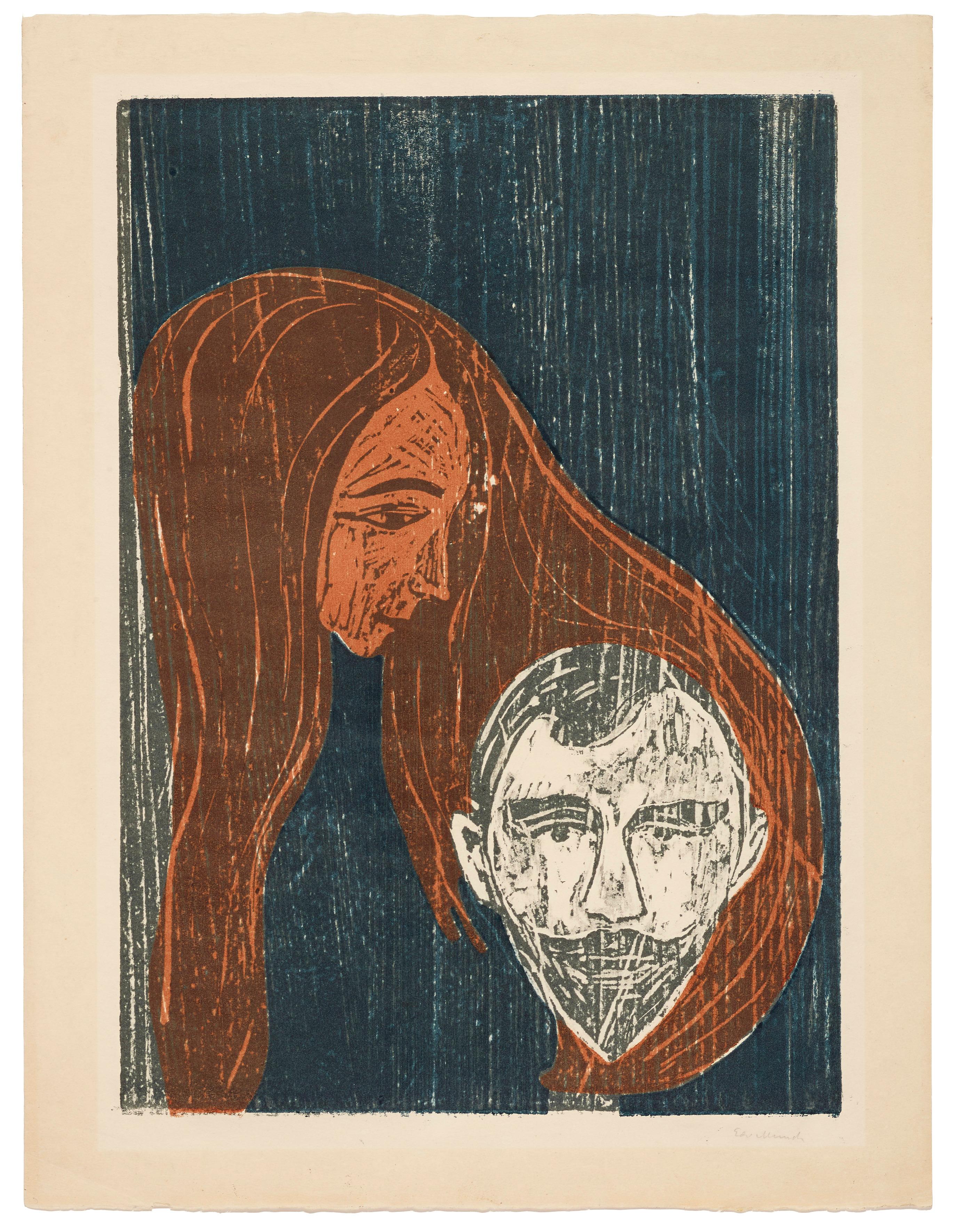
Peder Lund Art Advisory Associates is honored to have facilitated the placement of Edvard Munch's "Man's Head in Woman's Hair" (1896) with the Art Institute of Chicago — an acquisition that brings one of the artist's most psychologically powerful graphic works into permanent institutional care at the highest level. The work entered the Art Institute's collection in 2024 through the Harry B. and Bessie K. Braude Memorial Endowment Fund, and was presented to the public in the exhibition "Strange Realities: The Symbolist Imagination" (October 4, 2025 – January 5, 2026).
"Man's Head in Woman's Hair" is a color woodblock print on cream wove paper, measuring 63.5 × 48.3 cm (25 × 19 1/16 in.), signed in graphite lower right "Edv Munch." The image is among the most immediately arresting Munch ever made. At its center — small, pale, and almost childlike — is a man's face. Around it, above it, beneath it, flowing outward to the edges of the composition, is a woman's hair: dense, dark, undulating, overwhelming. The man does not struggle; he is simply held. Whether the holding is tenderness or possession, comfort or entrapment, the image declines to say. That productive ambiguity — the simultaneous suggestion of desire and dissolution, of the erotic as a force that both sustains and obliterates the self — is precisely what places this work at the center of Munch's symbolist project and at the center of his "Frieze of Life," the great cycle of paintings, prints, and drawings devoted to love, anxiety, and death that he conceived in the early 1890s and returned to throughout his career.
The technical means by which the image is realized are inseparable from its expressive force. Munch's approach to the color woodblock — developed during the mid-1890s in Paris and Berlin, in dialogue with the Japanese woodblock tradition and the Parisian avant-garde — was characteristically inventive. He cut his blocks apart with a jigsaw, inked each section in a different color, and reassembled them for printing: a method that exploited the grain and texture of the wood and produced, in the resulting print, a quality of material density that no other reproductive process could achieve. In "Man's Head in Woman's Hair," the dark, pressing weight of the hair and the pale isolation of the face are rendered with a physical immediacy that reproduction diminishes considerably. The work must be seen in person.
The work traveled internationally over more than a decade before its acquisition by the Art Institute of Chicago, appearing in some of the most significant Munch exhibitions of recent decades. It was shown as part of the "50 Graphic Works from the Gundersen Collection" exhibition at Bergen Kunstmuseum (2010–2011), which subsequently traveled to the Musée des Beaux-Arts de Caen and the Scottish National Gallery of Modern Art in Edinburgh. It was included in "Edvard Munch Angst/Anxiety" at ARoS Aarhus Kunstmuseum (2012–2013), one of the most thoroughly researched thematic surveys of Munch's psychological imagery; in "Scream & Respond" at Shanghai Jiushi Art Museum (2020–2021); and — in what is perhaps the most prestigious context of its exhibition history — in "Edvard Munch: A Poem of Life, Love and Death" at the Musée d'Orsay, Paris (2022–2023), the landmark retrospective that reestablished the terms on which Munch's practice is understood by international scholarly and curatorial consensus. It appeared most recently in "Edvard Munch: Beyond the Scream" at Hangaram Art Museum, Seoul (2024), before entering the Art Institute's collection.
Peder Lund Art Advisory Associates has, over many years, developed a position as one of the foremost advisors on the acquisition and placement of works by Edvard Munch in the international market. Our knowledge of the graphic oeuvre — its states and editions, its exhibition and provenance histories, its critical literature — is deep and continuously updated. It is from that position of specialist expertise that we were able to identify this work, assess its significance within the context of the Art Institute's existing holdings, and bring the transaction to conclusion. That the work now belongs permanently to the Art Institute of Chicago, where it will be accessible to scholars and the public in perpetuity, is an outcome of which we are very proud.