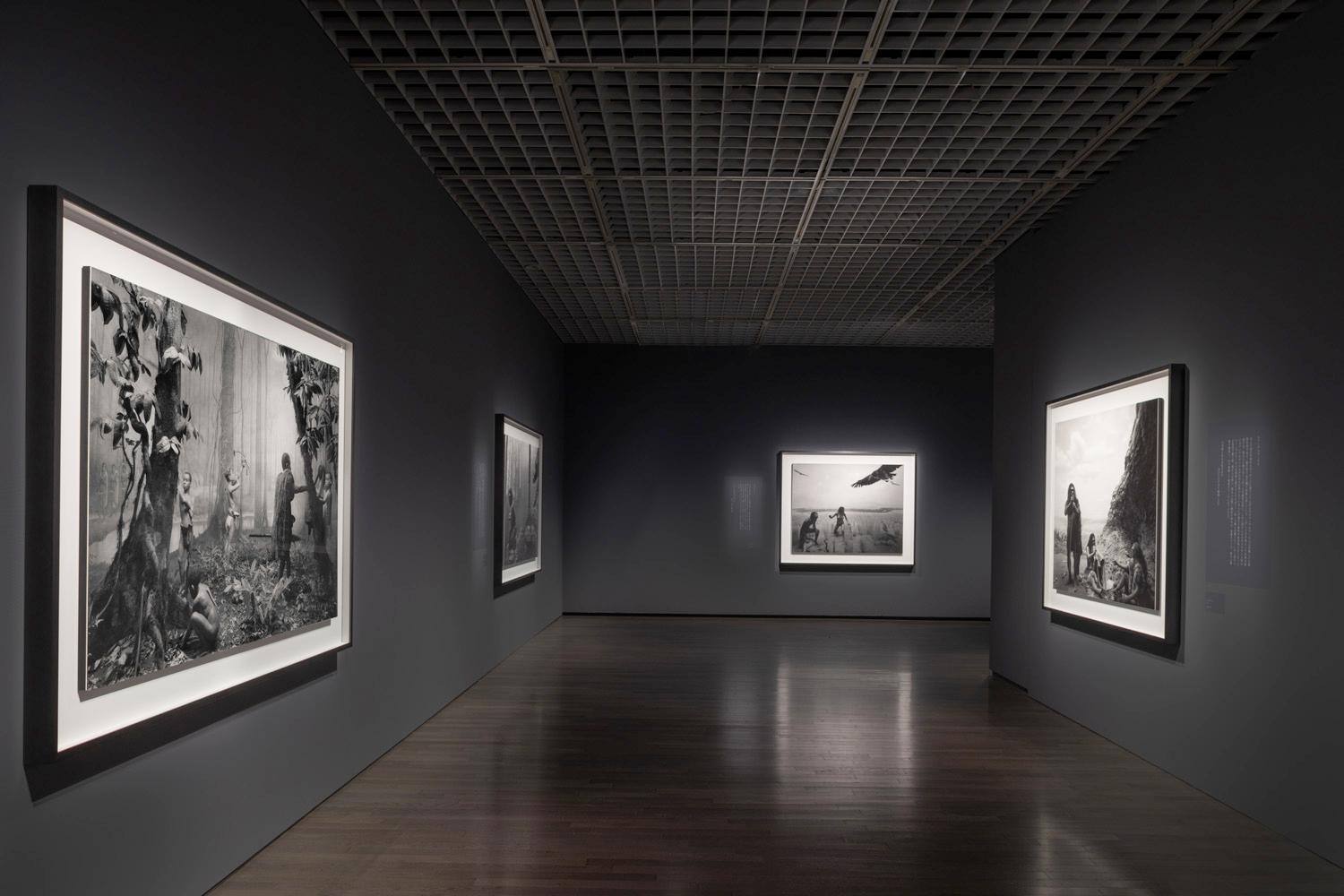
Peder Lund Art Advisory Associates is pleased to share that Peder Lund attended the opening of "Hiroshi Sugimoto: Extinction" at the National Museum of Modern Art, Tokyo — the most significant presentation of Sugimoto's photographic work in Japan in over twenty years, and an exhibition that marks a defining moment in the career of one of the great artists of our era. Peder Lund's relationship with Hiroshi Sugimoto spans three decades, during which he has worked consistently to bring Sugimoto's work before Scandinavian institutional audiences, arranging for his photographs to be shown in major museum exhibitions across the Nordic region. To be present in Tokyo at the opening of this retrospective is a privilege that reflects the depth and longevity of that connection.
Hiroshi Sugimoto (born 1948) occupies a singular position in the history of contemporary art. He is, above all, a photographer — but his practice extends far beyond photography into architecture, theater direction, calligraphy, ceramics, and waka poetry, and across all of these pursuits he brings the same quality of sustained, philosophically rigorous attention that defines his images. The point of origin for everything he does, as the exhibition makes clear, is gelatin silver photography: the medium he chose in the early 1970s and has never abandoned, and which he has developed with a technical and conceptual exactitude that places his work at the very summit of the form.
He moved to the United States in 1970 and, from 1974, began producing work while shuttling between New York and Japan — a dual geography that has informed his practice ever since, placing him in dialogue with both the traditions of Japanese visual culture and the conceptual frameworks of the Western contemporary art world. His early photographic series — "Dioramas," "Theaters," and "Seascapes" — were begun in the late 1970s and established him almost immediately as an artist of the first order. They also established the conceptual terms within which all his subsequent work can be understood: an investigation of time, light, perception, and the photographic medium itself as both a record of the visible world and a transformation of it into something entirely other.
"Hiroshi Sugimoto: Extinction" brings together approximately 60 gelatin silver photographs spanning five decades, tracing the evolution of Sugimoto's artistic universe across 13 of his photographic series. Organized in three chapters, the exhibition functions simultaneously as retrospective and manifesto — looking back across the full range of the work while proposing a final, encompassing theme that gives everything new resonance.
The first chapter presents the three series through which Sugimoto first came to international attention, all begun in the 1970s and 1980s. The "Dioramas" — photographs of natural history museum dioramas made with an exposure so precise that the stuffed animals appear entirely alive — are among the most philosophically complex images in the history of photography. Sugimoto was struck, visiting the American Museum of Natural History in New York, by the way a long exposure transformed taxidermy into apparent life: the camera, faithful to the light falling on the scene, could not distinguish between the living and the reconstructed. The resulting images raise questions about the nature of the photograph as a truth-claim that have not been exhausted in nearly fifty years of subsequent engagement. New additions to the series — including "Pokot" (2025), shown here for the first time — extend this visual account of human history across more than half a century of sustained thinking. Sugimoto has described the series as secretly conceived at its outset in 1975 as a complete history of life on earth; this exhibition represents its fullest realization to date.
The "Theaters" series, begun in 1978, deploys a different but equally disorienting photographic proposition: Sugimoto places his camera in a movie theater, opens the shutter at the beginning of a film, and closes it at the end. The entire film is exposed onto a single frame. The screen, receiving the light of an entire movie, becomes a pure white rectangle; the theater interior, illuminated only by that diffuse projection, is rendered in extraordinary detail. The resulting image shows an architecture of cultural ceremony in which the content of the screen has been entirely consumed by the time of its exposure. The film is gone; the space it inhabited remains.
The "Seascapes" series — begun in 1980 and continuing to the present — presents horizons dividing sea from sky from around the world, photographed with the same exposure and printed with the same tonal exactitude regardless of location. The Caribbean Sea, the Arctic Ocean, the Mediterranean, the Pacific: all are equalized by the camera's attention, all reduced to the same fundamental division of water and atmosphere, light and gray. They are among the most reproduced and most beloved images in contemporary photography, and the most formally severe. New "Seascapes" appear in the exhibition alongside the canonical examples.
The second chapter presents the series Sugimoto began developing from the late 1990s onward, in which the subject of the photograph is not landscape or architecture or constructed scene but pure form — the forms produced by human mathematics, science, and imagination. The "Conceptual Forms" series photographs mathematical models: plaster and metal objects produced in the nineteenth and early twentieth centuries by scientists and educators to make abstract equations tangible. Sugimoto photographs these models with the same formal attention and tonal precision he brings to everything else, producing images in which geometric surfaces of extraordinary complexity — pseudospheres, minimal surfaces, algebraic curves — are rendered as sensuous and almost bodily presences. The tension between the formal abstraction of the mathematical subject and the photographic luminosity of the image is one of the most productive in his practice.
The "Stylized Sculpture" series applies the same lens to the history of fashion: Sugimoto photographs archival fashion objects — costumes, garments, constructed forms — from major houses including, in this exhibition, Christian Dior, presenting them as sculpture. A new work, "Stylized Sculpture 120, Christian Dior, Bar, 1947" (2025), is shown here for the first time. The series extends his long meditation on the relationship between time and form: the garment, like the diorama and the theater, is a cultural artifact that photography can isolate, illuminate, and transform into something that seems to exist outside of time.
The final chapter, which gives the exhibition its title and its organizing concept, is composed of six series that together address what Sugimoto describes as his vision of extinction: the impending disappearance of the gelatin silver medium, his own approaching cessation as a working artist, and the broader patterns of loss and ending that run through all his work. The series in this chapter — "Pre-Photography Time-Recording Device," "Photogenic Drawing," "Portraits," "Lightning Fields," "Opticks," and "In Praise of Shadow" — chart the furthest reaches of his engagement with photography as a medium and as a philosophical proposition.
The "Lightning Fields" and "Photogenic Drawing" series in particular take the medium to its conceptual edge: images made by electricity discharged directly onto film, or by photosensitive paper exposed to light without the intervention of a camera. These are photographs that contain no photographer's decision about framing, angle, or exposure in the conventional sense — they are recordings of physical processes, images produced by the medium's own sensitivity to light and energy. That Sugimoto, one of the most technically refined photographers alive, should end his practice here — in images that bypass the camera entirely — is a gesture at once final and illuminating.
The title "Extinction" refers, in the first instance, to the gelatin silver process itself. As digital imaging has overtaken film across every commercial and artistic context, the infrastructure that supports gelatin silver photography — the papers, chemicals, equipment, and specialized expertise required to work at the level Sugimoto demands — is disappearing. His commitment to the medium is absolute and, in the current environment, increasingly singular. The exhibition is, among other things, a testament to that commitment and an elegy for what will be lost when it can no longer be sustained.
But extinction, as Sugimoto makes clear, is also a broader theme — a basso continuo running through the entire exhibition. The dioramas preserve species that have long since disappeared. The theaters record architectural spaces that have been demolished. The seascapes document a world whose horizons are already changing. The mathematical models preserve forms of knowledge that have passed out of active use. At every level, Sugimoto's practice is an act of preservation against loss — and "Extinction" is the name he gives, finally and without evasion, to the force against which that preservation is directed.
Peder Lund's engagement with Hiroshi Sugimoto and his work extends across thirty years. In that time, he has worked persistently and with deep personal conviction to bring Sugimoto's photographs before Nordic institutional audiences — arranging for major works from his series to be included in museum exhibitions across Scandinavia, introducing the work to collectors, curators, and institutions who have since built lasting engagement with it. That advocacy reflects something more than a commercial or advisory relationship; it reflects a belief, held from the beginning, that Sugimoto's practice represents one of the most serious and enduring contributions to visual culture made by any artist of the past half century, and that Scandinavian audiences and institutions are the natural home for work of this philosophical depth and formal rigor.
"Hiroshi Sugimoto: Extinction" is on view at the National Museum of Modern Art, Tokyo, through September 13, 2026. Peder Lund Art Advisory Associates warmly congratulates the artist and the museum on an exhibition of enduring significance.