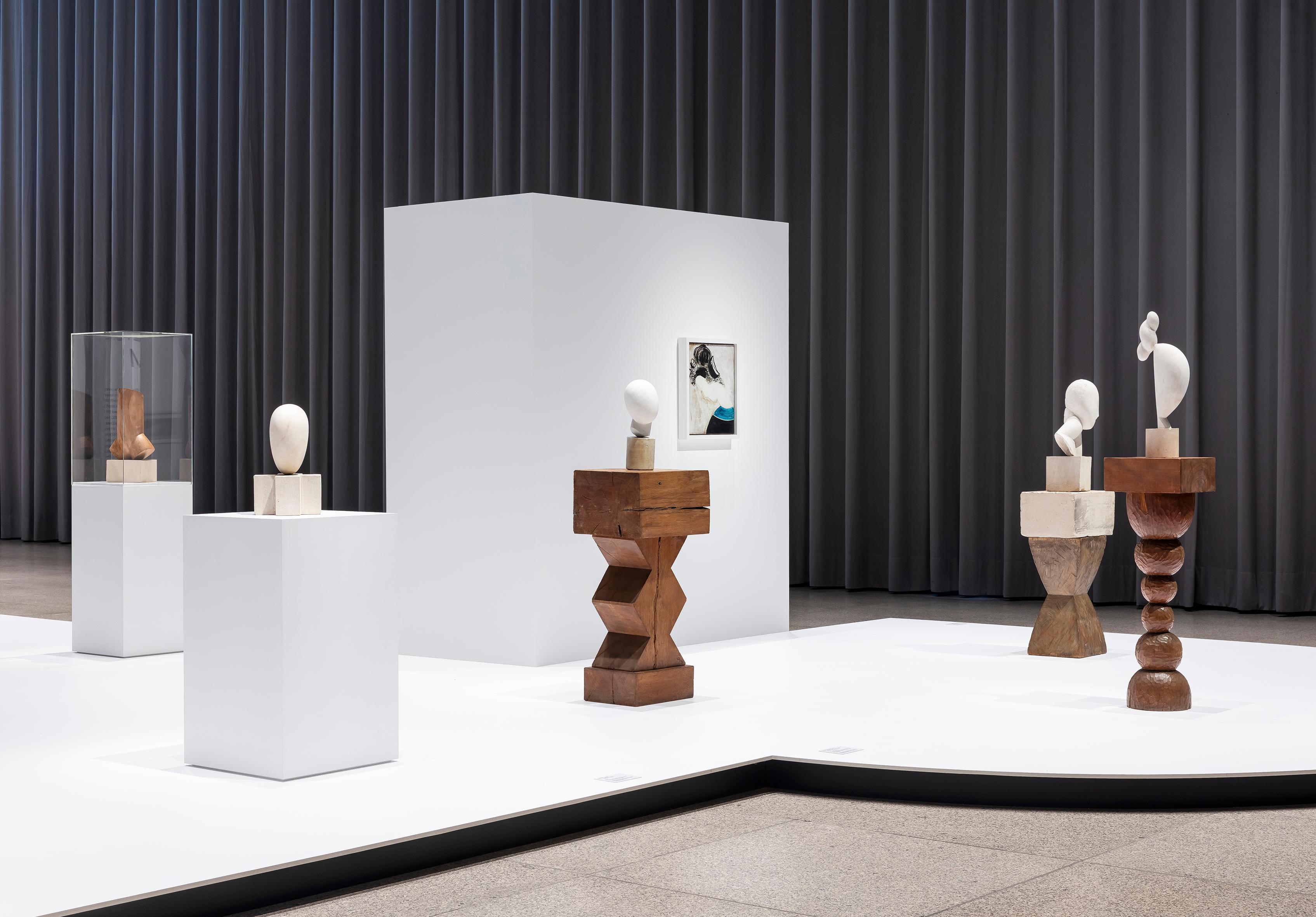
Constantin Brâncuși’s landmark retrospective is currently on view at the Neue Nationalgalerie in Berlin through August 9, 2026. Organized in close cooperation with the Centre Pompidou in Paris, this exceptional exhibition marks the first major survey of the artist’s work in Germany in over fifty years. Regarded as the founder of modern sculpture, Brâncuși (1876–1957) developed his distinctive style in Paris from 1907 onwards, creating organic forms reduced to their absolute essence that established him as a pioneer of sculptural abstraction.
The exhibition brings together more than 150 sculptures, photographs, drawings, films, and rarely seen archival materials from the Centre Pompidou alongside other public and private international collections. Key masterpieces such as The Kiss, Bird in Space, Sleeping Muse, and Endless Column highlight Brâncuși’s continuous search for an artistic ideal, reflected in the formal variations of a few central motifs and his playful, masterful use of different materials, surfaces, pedestals, light, and movement.
Rather than following academic clay modeling, Brâncuși abandoned the tradition of his brief mentor Auguste Rodin to create his sculptures directly in stone or wood through taille directe (direct carving). His search for the "essence of things" is visible in the gradual elimination of realistic details, transforming his subjects into highly polished, stylized shapes. This simplification frequently introduced a deliberate ambiguity; in works like Princess X or the Torso of a Young Man, feminine and masculine attributes merge into metamorphic forms that challenged binary gender roles, echoing the Dadaist spirit of his close Parisian circle, which included Marcel Duchamp, Man Ray, and Tristan Tzara.
A definitive centerpiece of the retrospective is a partial reconstruction of Brâncuși’s legendary studio at Impasse Ronsin, shown complete with his tools and furniture outside of Paris for the very first time since its bequest to the French state in 1957. For Brâncuși, the studio was a Gesamtkunstwerk – a total work of art, living space, and exhibition room where he meticulously orchestrated his sculptures. He rejected traditional artistic hierarchies by hand-crafting complex geometric pedestals out of wood or limestone, viewing them not as mere displays but as integral, dynamic components of the sculptures themselves.
The exhibition also highlights how Brâncuși used photography and film to capture "form in motion". By capturing reflections on mirror-like polished bronzes – sometimes even mounting works like Leda on motorized ball bearings to spin in slow, perpetual rotation - he allowed his sculptures to dissolve their material boundaries into the surrounding space. Presented within Ludwig Mies van der Rohe’s iconic modernist pavilion, the retrospective offers an unparalleled look at a practice that fundamentally redefined the possibilities of modern sculpture.
Image: Brancusi, exhibition view, Neue Nationalgalerie, 2026, Photo: Neue Nationalgalerie – Stiftung Preußischer Kulturbesitz / David von Becker
© Succession Brancusi - All rights reserved / VG Bild-Kunst, Bonn 2026